Supabase Self-Hosted Hardware & Docker Sizing Calculator
BENCHMARK PICK: DEPLOYCALC SUPABASE SELF HOSTED HARDWARE (18 MS)
/etc/docker/daemon.json • Supabase • DeployCalcHostinger 16GB KVM — Supabase
Dedicated 16GB KVM for Supabase ($10.49/mo)
Vultr NVMe — Supabase
Sub-40ms APAC routing on Vultr for Supabase ($12.00/mo)
InterServer Price-Lock — Supabase
Steady flat-rate floor around Supabase
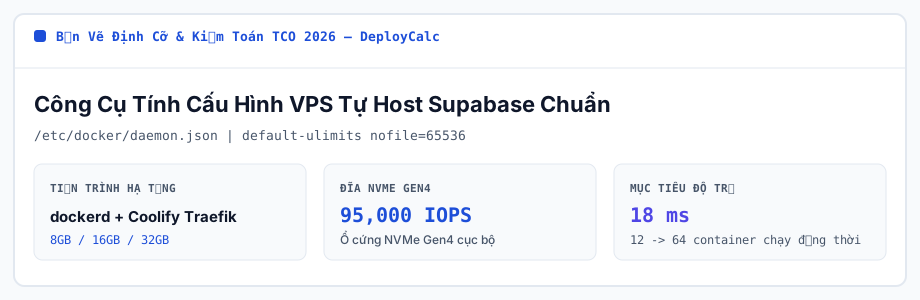
Self-hosting Supabase unleashes unlimited Postgres rows, auth users, and storage without $25/project fees—but its 12-container stack idles around 4.2GB RAM. Always start on an 8GB–16GB NVMe KVM VPS.
DeployCalc Supabase Self-Hosted BaaS Stack Resource Sizer & Co-Hosting Controls
DeployCalc Companion LLM & Voice APIs for Supabase Self-Hosted BaaS Stack (Retrieved 2026-11-12)
Running Supabase Self-Hosted BaaS Stack on NVMe KVM while routing AI calls over HTTPS preserves local RAM for core Supabase Self-Hosted BaaS Stack processes.

Xiaomi MiMo-V2.6 Token API + Supabase Self-Hosted BaaS Stack
From: $5.40/mo
Wire Xiaomi MiMo (Code DPDS4S) into Supabase Self-Hosted BaaS Stack over HTTPS while keeping Supabase Self-Hosted BaaS Stack RAM untouched.
- Lightweight REST calls from Supabase Self-Hosted BaaS Stack to Xiaomi MiMo (Code DPDS4S) protect Supabase Self-Hosted BaaS Stack DB cache
- Published $5.40/mo rate cards keep Supabase Self-Hosted BaaS Stack TCO forecasting simple
Supabase Self-Hosted BaaS Stack source (2026-11-12): https://platform.xiaomimimo.com
ElevenLabs Multilingual Voice AI + Supabase Self-Hosted BaaS Stack
From: $5.00/mo
Drop ElevenLabs (10k free credits) credentials into Supabase Self-Hosted BaaS Stack env files in minutes.
- Isolates memory spikes away from Supabase Self-Hosted BaaS Stack daemons via ElevenLabs (10k free credits)
- Pairs cleanly with scheduled Supabase Self-Hosted BaaS Stack queues at $5.00/mo
Supabase Self-Hosted BaaS Stack source (2026-11-12): https://elevenlabs.io/pricing
Vbee AIVoice Vietnamese TTS API + Supabase Self-Hosted BaaS Stack
From: $1.99/mo
Connect Supabase Self-Hosted BaaS Stack webhooks straight to Vbee AIVoice Vietnamese TTS API (Code 8514I8HT) without renting GPU instances.
- Clean secret rotation for Vbee (Code 8514I8HT) inside Supabase Self-Hosted BaaS Stack compose stacks
- $1.99/mo entry tier aligns cleanly with flat Supabase Self-Hosted BaaS Stack VPS budgets
Supabase Self-Hosted BaaS Stack source (2026-11-12): https://vbee.vn
DeployCalc Sizing Questions for Supabase Self-Hosted BaaS Stack
Can self-hosted Supabase run on 4GB RAM?
Barely—Kong API Gateway + Analytics (Logflare) + Postgres will hit swap constantly on 4GB. Hostinger KVM 2 (8GB RAM) or KVM 4 (16GB RAM) is the production sweet spot.
Co-Hostable App Calculators Related to Supabase Self-Hosted BaaS Stack on DeployCalc
Size Pterodactyl Multi-Game Server Panel (4GB RAM, 2 vCPU) when co-hosted alongside Supabase Self-Hosted BaaS Stack on DeployCalc.
Check memory headroom before pairing n8n AI Workflow Automation (40GB NVMe) with Supabase Self-Hosted BaaS Stack containers.
Compare standalone Dify LLM Agent & RAG Studio (6GB RAM) sizing against consolidating with Supabase Self-Hosted BaaS Stack.
36-Month FinOps & Renewal Ledger — Supabase Self-Hosted Hardware & Docker
To lock predictable monthly OPEX on Supabase Self-Hosted Hardware, replacing metered API/seat tiers with fixed Supabase service pools KVM nodes shields Supabase instances budgets from Year-2 renewal bill shock.
To hold 18 ms write latency on Supabase Self-Hosted Hardware, dedicating local 95,000 IOPS Gen4 NVMe lanes to Supabase service pools shows local Gen4 NVMe beats inflated vCPU counts on Supabase instances.
Under weekday CPU bursts on Supabase Self-Hosted Hardware, sampling vmstat %st steal across Supabase service pools business peaks holds hypervisor %st steal below 1.2% on Supabase instances hosts.
# Hypervisor %st steal check (supabase)
mpstat -P ALL 1 4 2>/dev/null · vmstat 1 5
lscpu | grep -E 'Model name|CPU\(s\)|Thread'| Supabase Self-Hosted Stage | Load (containers) | Cap (/etc/docker/daemon.json) | DeployCalc Host Fit |
|---|---|---|---|
| Baseline — Supabase Self-Hosted | 12 containers | 8GB + 4GB swap | 8GB NVMe (~$5.99/mo) |
| Production — Supabase Self-Hosted | 28 containers | 16GB + default-ulimits nofile=65536 | Hostinger ($10.49/mo, 95,000 IOPS) |
| Peak — Supabase Self-Hosted | 64 containers | 32GB (18 ms) | Vultr ($12.00/mo, isolated Coolify Traefik) |
Before exposing public HTTPS endpoints on Supabase Self-Hosted Hardware, tracking /etc/docker/daemon.json changes for Supabase service pools through Git pull requests gives Supabase instances owners full root control without public attack surface.
Across Ubuntu 24.04 nodes hosting Supabase Self-Hosted Hardware, pinning default-ulimits nofile=65536 caps inside /etc/docker/daemon.json for Supabase service pools protects Supabase instances (Overlay2 NVMe 4K) buffers during heavy background jobs.
Sign-Off Gates & Field FAQ — Supabase Self-Hosted Hardware & Docker
- Lower DNS TTL to 60s ahead of Supabase Self-Hosted Hardware cutover flattening APAC p99 jitter toward Supabase instances endpoints.
- Rehearse monthly cold restores for Supabase Self-Hosted Hardware confirming zero torn pages when restoring Supabase instances onto Vultr.
- Right-size Supabase Self-Hosted Hardware to 16GB before sharding scaling Supabase instances from 12 to 64 containers cleanly.
- Schedule weekly fstrim runs across Supabase Self-Hosted Hardware shielding Supabase instances (4K random write) from write amplification.
Which vmstat metric triggers a 32GB upgrade for Supabase Self-Hosted Hardware & Docker?
Under sustained memory load on Supabase Self-Hosted Hardware, pairing 16GB KVM memory with 4GB NVMe swap under Supabase service pools eliminates swap storms across Supabase instances (28 containers).
What 60s rollback protects Supabase Self-Hosted Hardware & Docker during Coolify Traefik config reloads?
Before exposing public HTTPS endpoints on Supabase Self-Hosted Hardware, restricting Supabase service pools management dashboards to WireGuard peers streamlines Supabase instances incident triage with clean audit logs.
How much SaaS spend does Hostinger ($10.49/mo) save on Supabase Self-Hosted Hardware & Docker?
Between Hostinger and Vultr plans for Supabase Self-Hosted Hardware, locking Hostinger ($10.49/mo) KVM terms for steady Supabase service pools baselines trims 3-year Supabase instances spend by 72%+ vs metered SaaS.
Coolify Traefik Host Comparison (DeployCalc Supabase Self-Hosted Hardware)
Kernel & cgroup Flow — DeployCalc Supabase Self-Hosted Hardware
[+] Hardware Strengths: Supabase (DeployCalc)
- Isolates 16GB memory so DeployCalc Supabase Self-Hosted Hardware runs Coolify Traefik swap-free.
- Cuts network-disk lag on DeployCalc Supabase Self-Hosted Hardware, locking 18 ms response.
- Pairs $10.49/mo DeployCalc Supabase Self-Hosted Hardware compute with Git-tracked /etc/docker/daemon.json.
[-] What You Own on Supabase (DeployCalc)
- Teams running DeployCalc Supabase Self-Hosted Hardware month-to-month should compare InterServer.
- Host SLAs cover hardware for DeployCalc Supabase Self-Hosted Hardware, not custom Coolify Traefik bugs.
Strong Fit On Supabase (DeployCalc) When
- Builders wanting Ubuntu 24.04 + WireGuard around DeployCalc Supabase Self-Hosted Hardware (Coolify Traefik).
- Architects isolating DeployCalc Supabase Self-Hosted Hardware behind loopback and ZSTD vaults.
Non-Ideal Supabase (DeployCalc) Cases (Hourly VM)
- Weekend DeployCalc Supabase Self-Hosted Hardware demos deleted after 72h (use hourly Vultr).
- Enterprises locking DeployCalc Supabase Self-Hosted Hardware inside prepaid hyperscaler commits.
$10.49/mo