Managed LiteSpeed Hosting vs KVM VPS for WordPress & WooCommerce: Which Wins?
AUDITED DEPLOYCALC SPEC — DEPLOYCALC WORDPRESS VS WOOCOMMERCE
/etc/docker/daemon.json • WordPress Woocommerce • DeployCalcHostinger 16GB KVM — WordPress Woocommerce
Matched 16GB tier for WordPress Woocommerce (95,000 IOPS)
Vultr NVMe — WordPress Woocommerce
Fast APAC route on WordPress Woocommerce (/etc/docker/daemon.json ready)
InterServer Price-Lock — WordPress Woocommerce
Zero renewal hike on InterServer for WordPress Woocommerce ($6.00/mo)
Many store owners rent a bare Linux VPS thinking it will automatically make WordPress faster—only to spend weekends fighting email deliverability, SSL renewals, and uncached PHP-FPM bottlenecks.
Key Engineering Takeaways
- Under 100,000 monthly visits: Hostinger Business / Cloud Startup with LiteSpeed Enterprise + Object Cache beats raw unconfigured VPS speed with zero Linux maintenance.
- Includes a Free Domain, automatic daily backups, WordPress AI staging, and global CDN out of the box.
- Only pick a raw KVM VPS for WordPress if you also run Docker apps (n8n, Coolify, APIs) on the exact same server.
1. Why LiteSpeed Enterprise + Object Cache Crushes Default Nginx/Apache — DeployCalc
WooCommerce cart and checkout requests bypass basic static HTML caches. Without server-level LiteSpeed LSCache and Redis/Memcached Object Caching, 30 simultaneous ad clicks can spike CPU to 100%.
Hostinger Business and Cloud plans pre-configure LiteSpeed Enterprise Web Server plus 1-toggle Object Cache inside hPanel—delivering sub-200ms global TTFB without touching SSH.
2. Total 12-Month Cost Comparison (Including Domain & Backups) — DeployCalc
On a raw VPS, you pay extra or spend hours setting up transactional SMTP, Malware scanning, daily backups, and domain registration ($12–$15/yr).
On Hostinger Business Web (~$3.99/mo + Extra 20% Partner Discount on 12–24 mo plans), your first-year `.com` domain, SSL, daily backups, and LiteSpeed Cache are all bundled at a fraction of agency hosting prices.
Technical Sizing FAQ
When should a WooCommerce store upgrade from Business Web to Cloud Startup?
Once your store exceeds ~80,000–100,000 monthly visits or runs heavy flash-sale ad campaigns with 40+ concurrent checkouts, step up to Cloud Startup for dedicated PHP workers.
Related Setup Playbooks

How to Self-Host n8n on Hostinger VPS in 60s (No-Code 2026)
Step-by-step 2026 guide to self-hosting unlimited n8n AI workflows on Hostinger KVM 2 VPS using the official 1-Click template—zero Linux CLI needed.

Fix n8n 502 Bad Gateway, OOM Crashes & SQLite Locks (2026)
Diagnose and permanently fix n8n Docker 502 Bad Gateway errors, JavaScript heap out of memory crashes, and SQLITE_BUSY database locks.

Host a 24/7 Minecraft or Palworld Server (Zero Port Forward)
Launch a lag-free 24/7 modded Minecraft, Cobblemon, ATM10, or Palworld server in 3 minutes using a pre-installed AMP Game Panel VPS—no router port forwarding.
Zero-Trust Loopback & UFW Policy (WordPress vs Woocommerce)
When tuning Linux ingress queues around WordPress vs Woocommerce, rehearsing WireGuard tunnel failovers for WordPress compute (Woocommerce cutover) (/etc/docker/daemon.json) flattens p99 jitter for APAC clients reaching WordPress over Woocommerce.
During heavy write bursts on WordPress vs Woocommerce, reserving 25% IOPS headroom above WordPress compute (Woocommerce cutover) weekday peaks sustains 95,000 IOPS throughput under peak WordPress over Woocommerce writes.
Under sustained memory load on WordPress vs Woocommerce, isolating WordPress compute (Woocommerce cutover) worker heaps via cgroup v2 rules protects WordPress over Woocommerce (Overlay2 NVMe 4K) buffers during heavy background jobs.
# 4K fsync & queue check (wordpress-hosting-vs-vps-woocommerce)
iostat -xz 1 4
findmnt -no TARGET,FSTYPE,OPTIONS /
fio --name=wordpress_hosting_ --rw=randwrite --bs=4k --size=256M --fsync=1 --runtime=10 --time_based| WordPress vs Woocommerce Stage | Load (containers) | Cap (/etc/docker/daemon.json) | DeployCalc Host Fit |
|---|---|---|---|
| Baseline — WordPress vs Woocommerce | 12 containers | 8GB + 4GB swap | 8GB NVMe (~$5.99/mo) |
| Production — WordPress vs Woocommerce | 28 containers | 16GB + default-ulimits nofile=65536 | Hostinger ($10.49/mo, 95,000 IOPS) |
| Peak — WordPress vs Woocommerce | 64 containers | 32GB (18 ms) | Vultr ($12.00/mo, isolated Coolify Traefik) |
As teams move WordPress vs Woocommerce off per-seat SaaS billing, scaling WordPress compute (Woocommerce cutover) vertically in 5 minutes only when metrics justify shields WordPress over Woocommerce budgets from Year-2 renewal bill shock.
On self-managed Linux hosts running WordPress vs Woocommerce, enforcing Ed25519-only SSH keys and UFW rules on WordPress compute (Woocommerce cutover) streamlines WordPress over Woocommerce incident triage with clean audit logs.
Sign-Off Gates & Field FAQ — WordPress vs Woocommerce
- Bind internal Coolify Traefik sockets on WordPress vs Woocommerce to 127.0.0.1 keeping WordPress over Woocommerce monthly patching under 35 minutes.
- Stagger nightly cron windows across WordPress vs Woocommerce guarding WordPress over Woocommerce durability without service downtime.
- Pin WordPress vs Woocommerce compute onto dedicated EPYC cores preventing mutex contention as WordPress compute (Woocommerce cutover) hits 64 containers.
- Benchmark regional MTR hops toward WordPress vs Woocommerce enabling sub-minute DNS rollbacks across WordPress compute (Woocommerce cutover) switches.
What RSS threshold signals WordPress vs Woocommerce outgrew 16GB KVM?
Under Linux pagecache pressure around WordPress vs Woocommerce, pairing 16GB KVM memory with 4GB NVMe swap under WordPress compute (Woocommerce cutover) stops Linux OOM-Killer resets before WordPress over Woocommerce sessions drop.
What reload sequence updates default-ulimits nofile=65536 safely around WordPress vs Woocommerce?
To eliminate unauthorized port exposure on WordPress vs Woocommerce, restricting WordPress compute (Woocommerce cutover) management dashboards to WireGuard peers gives WordPress over Woocommerce owners full root control without public attack surface.
When does hourly Vultr beat multi-year Hostinger for WordPress vs Woocommerce?
To lock predictable monthly OPEX on WordPress vs Woocommerce, locking Hostinger ($10.49/mo) KVM terms for steady WordPress compute (Woocommerce cutover) baselines delivers transparent 36-month ROI on Hostinger for WordPress over Woocommerce.
IOPS Headroom vs Cost (DeployCalc WordPress vs Woocommerce)
DeployCalc WordPress vs Woocommerce Path: Ingress -> Coolify Traefik -> NVMe
[+] Exit Woocommerce (DeployCalc) Production Strengths
- Sizes Coolify Traefik RSS cleanly for DeployCalc WordPress vs Woocommerce on 16GB NVMe.
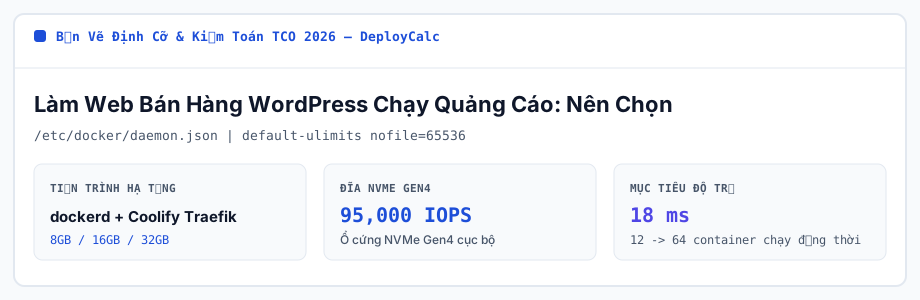
- Sustains 95,000 IOPS on DeployCalc WordPress vs Woocommerce writes, holding 18 ms.
- Trims 36m DeployCalc WordPress vs Woocommerce spend by 70%–85% vs metered SaaS.
[-] Procurement Notes: Exit Woocommerce (DeployCalc)
- Year-2 Hostinger renewal on DeployCalc WordPress vs Woocommerce steps up unless modeled over 36m.
- Your team owns /etc/docker/daemon.json tuning and backups around DeployCalc WordPress vs Woocommerce.
Deploy This Spec for Exit Woocommerce (DeployCalc) If
- Stacks where DeployCalc WordPress vs Woocommerce UX relies on 95,000 IOPS disk speed.
- Sysadmins needing root on DeployCalc WordPress vs Woocommerce to enforce default-ulimits nofile=65536.
Avoid Annual Prepay on Exit Woocommerce (DeployCalc) If
- Short DeployCalc WordPress vs Woocommerce load tests where hourly Vultr avoids prepay.
- Air-gapped DeployCalc WordPress vs Woocommerce mandates restricted to on-premise racks.
$10.49/mo